
What you'll find in this section
Data about
- Places of worship, including faith type and average attendance
- Most common religious affiliations
- How membership in faith traditions has changed over time
Key Findings
- Historically, the Greater Evansville Region was dominated by Mainline Protestant denominations. Over time, other Christian denominations, including Catholics and Evangelicals, gained more visibility.
- Evangelicals have been the most populous denomination since 1980. Catholics and Mainline Protestant membership is falling.
- Henderson County has the highest proportion of Evangelicals (34%) and the second highest proportion of Catholics (11%).
- Posey County has the lowest proportion of Evangelicals (15%) and the highest proportion of Mainline Protestants (12%).
Where you live matters
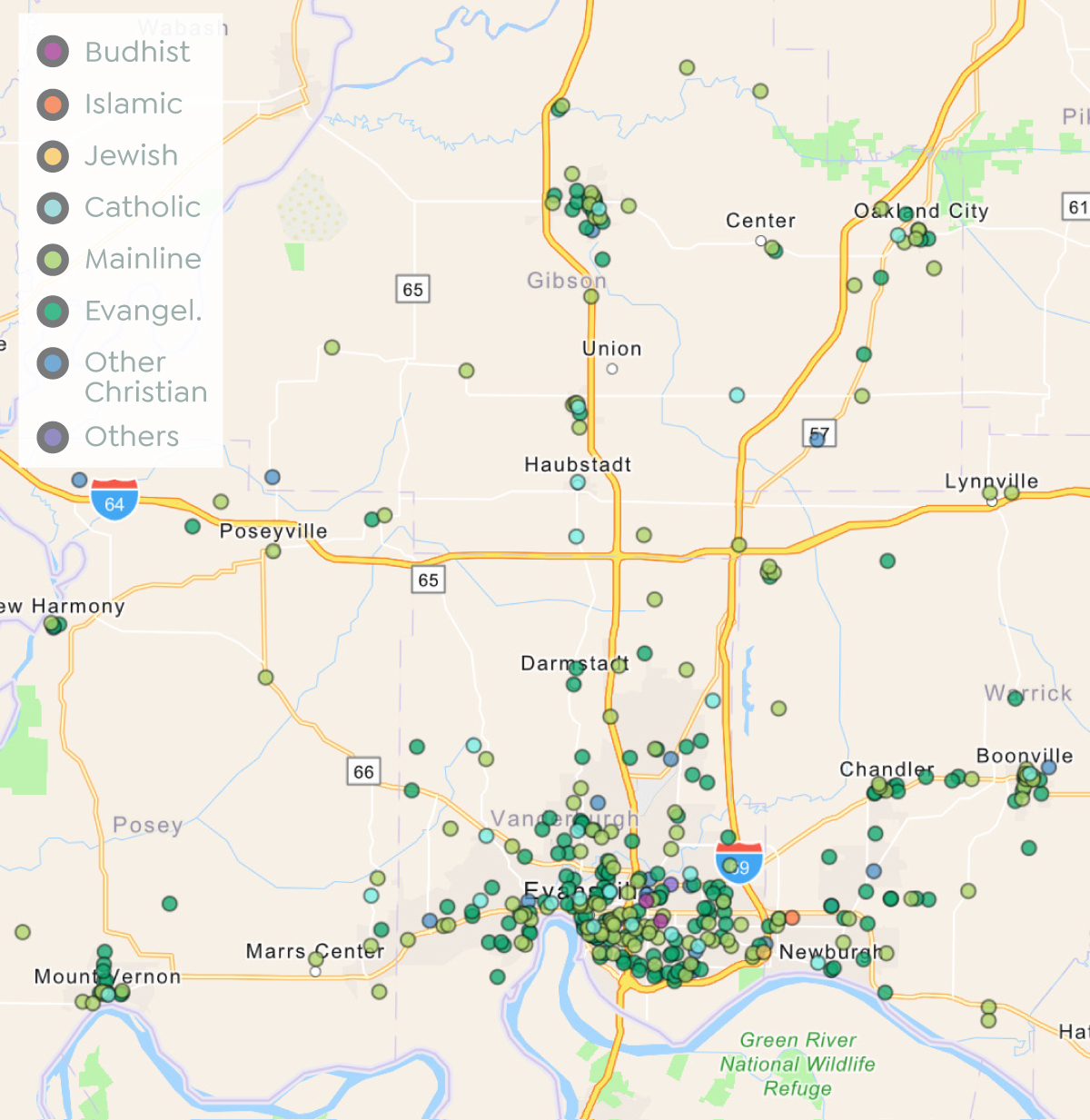
You can trace the history of the city and religion by looking at the location of places of worship. Areas developed in the 19th and early 20th centuries have many Catholic and Mainline churches. Evangelical churches have proliferated across the region, while the Jewish synagogue has moved from downtown to Washington Avenue and eventually to Newburgh Road as members moved further out from the city.
Religious institutions significantly contributed to the growth of education, culture, and development in the Evansville region. Many early settlers were religious communities representing Protestant denominations such as Methodists, Baptists, and Presbyterians. Religious communities also serve as a community life center through civic engagement and social services. They provide services like homeless shelters, food banks, disaster assistance, poverty relief, counseling, and addiction recovery.
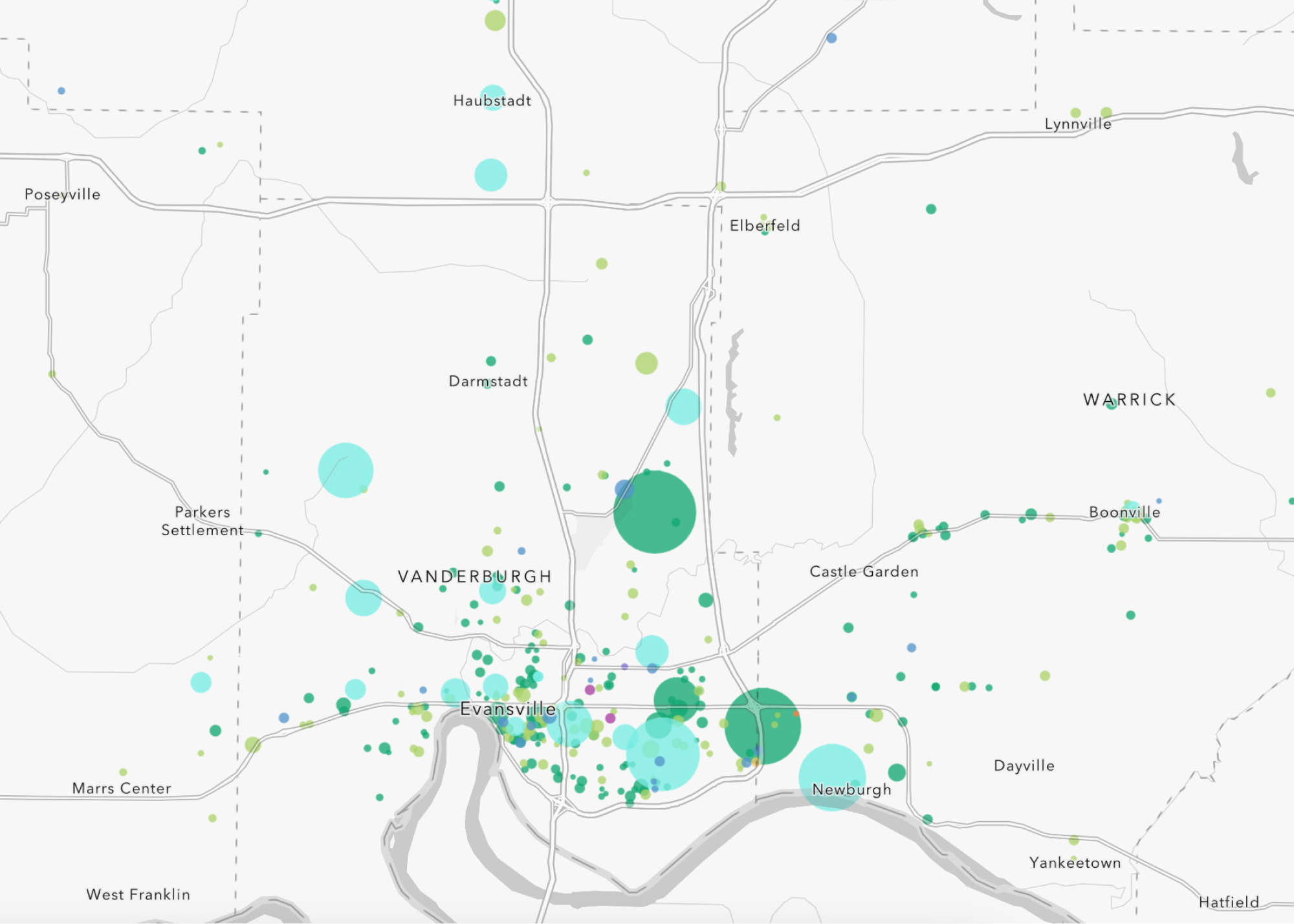
Places of worship by faith type and average attendance
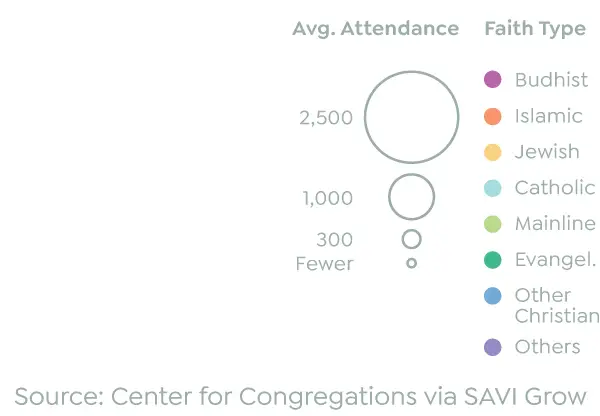
Catholic parishes tend to be the larger congregations in the region, but there are hundreds of small Evangelical or Mainline Protestant churches across the region. The suburbs are home to a few very large Evangelical churches.
Click here to explore this map
Evansville Prominent Religious Groups
The region’s 15 largest religious bodies consist of over 250 congregations and more than 100,000 adherents. The largest single group is the Catholic Church, with almost 25,000 adherents across 14 parishes. The second and third largest groups are Evangelical: the Southern Baptist Convention and non-denominational Christian Churches. These are followed by Methodists, a mainline denomination, and the Church of Christ, another evangelical group.
These five groups account for 80,000 adherents and illustrate the ecumenical diversity within Christianity in Evansville. The breadth of cultures and traditions across the region requires intentional coordination to address shared concerns like poverty and homelessness.
Religious bodies in the Evansville region ranked by number of adherents
| Rank | Religious Body | Tradition | Family | Adherents (Congregations) |
|---|---|---|---|---|
| 1 | Catholic Church | Catholic | Catholic Liturgical | 24,879 (14) |
| 2 | Southern Baptist Convention | Evangelical Protestant | Baptist | 16,674 (46) |
| 3 | Non-denominational Christian Churches | Evangelical Protestant | Other Groups | 15,980 (37) |
| 4 | United Methodist Church | Mainline Protestant | Methodist | 11,754 (60) |
| 5 | Christian Churches and Churches of Christ | Evangelical Protestant | Restorationists | 11,667 (18) |
| 6 | Lutheran Church-Missouri Synod (LCMS) | Evangelical Protestant | Lutheran | 5,726 (8) |
| 7 | General Association of General Baptists | Evangelical Protestant | Baptist | 3,398 (11) |
| 8 | United Church of Christ | Mainline Protestant | United Church of Christ | 3,017 (15) |
| 9 | Church of the Nazarene | Evangelical Protestant | Holiness | 2,894 (18) |
| 10 | Assemblies of God, General Council of the | Evangelical Protestant | Pentecostal | 2,869 (12) |
| 11 | Church of Jesus Christ of Latter-day Saints | Latter-day Saints | Latter-day Saints (Mormonism) | 2,426 (5) |
| 12 | American Baptist Churches in the U.S.A. | Mainline Protestant | Baptist Family | 2,231 (6) |
| 13 | Hindu, Traditional Temples | Hinduism | Hinduism Family | 1,731 (1) |
| 14 | Presbyterian Church (U.S.A.) | Mainline Protestant | Presbyterian/Reformed | 1,209 (11) |
| 15 | Jehovah's Witnesses | Jehovah's Witnesses | Adventist | 1,164 (5) |
Source: Association of Religion Data Archives
Toward that end, Evansville Mayor Stephanie Terry created an interfaith council in 2024.1 The group will meet quarterly and advise the mayor “on matters that affect the spiritual, faith and religious well-being of the community.”2
A Changing Religious Landscape
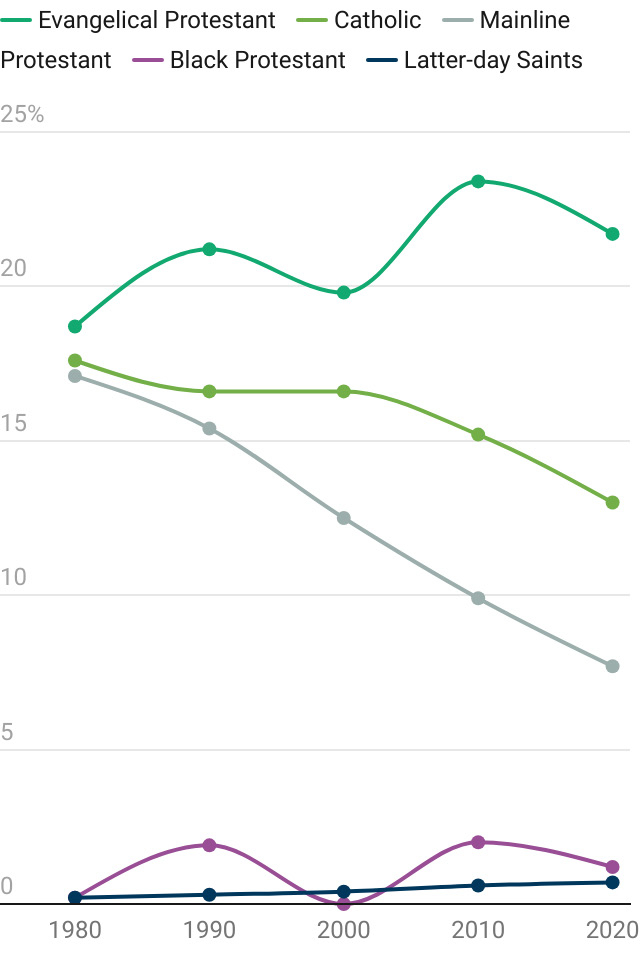
Based on data from the American Religion Data Archives (ARDA), we can identify trends in adherents of religious groups. In 1980, Evangelicals, Catholics, and Mainline Protestants each made up about one-sixth of the population. Between 1980 and 2020, the number of Evangelical Protestants grew gradually while the number of Mainline Protestants declined. The number of Catholics began to decline after 2000.
Black Protestants and Latter-day Saints have grown since 1980, contributing to Evansville’s religious diversity. Other religions, such as Islam, Buddhism, and Hinduism, are growing, but their numbers remain smaller compared to Christian traditions.
Protestants are the majority religious tradition in the Greater Evansville Region, but their majority varies by county. For example, Henderson has the highest percentage of Evangelicals (34%) and the second largest percentage of Catholics (11%). On the other hand, Posey County has the lowest percentage of Evangelicals (15%), the highest percentage of Mainline Protestants (12%), and Latter-day Saints (2%). Gibson has the highest percentage of Catholics (18%).
Evangelicals have been increasing while other Protestants and Catholics are declining in number
Adherents by faith group as percent of population
Source: Association of Religion Data Archives
Notes
- Goble N. Evansville mayor creates interfaith council. Tri-State Homepage. January 31, 2024. https://www.tristatehomepage. com/news/local-news/vanderburgh-county/evansville-news/ evansville-mayor-creates-interfaith-council/
- Yaney J. Mayor Terry announces Interfaith Council Wednesday. 14 News. Jannuary 30, 2024. https://www.14news. com/2024/01/31/mayor-terry-announce-interfaith-councilwednesday/
Where You Live Matters is a product of Grow
in partnership with The Polis Center.
Guide