
What you'll find in this section
Data about
- Median household income
- Education, poverty, and unemployment
- Children in need of services
Key Findings
- The Greater Evansville Region has a lower median household income ($65,812) than the state ($67,173 and the country ($75,149).
- Women working full-time in Posey County earn $24,966 less per year than full-time men. The difference is $11,029 in Henderson County, the lowest gap in the region.
- One-third of white and Latino residents have a high school diploma and no further education. The rate is higher for Black residents (39%) and lower for Asians (18%).
- Gibson and Posey counties have the lowest unemployment rates (2.8%), followed by Warrick County (3.3%). Henderson County’s rate is 3.8%, and unemployment is 4.7% in Vanderburgh County.
Where you live matters
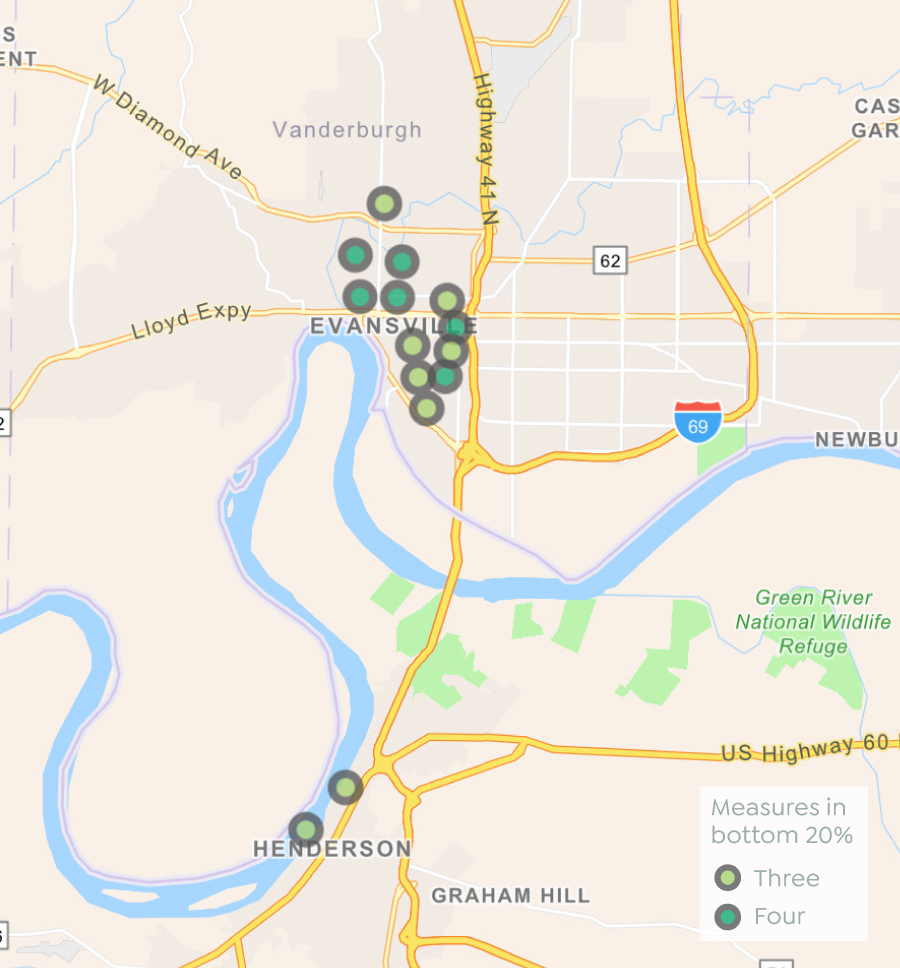
This map shows areas where multiple socioeconomic barriers overlap. These places rank in the bottom 20% in at least three of the following measures: median household income, share of adults without a diploma, poverty rate, and unemplotment rate. These neighborhoods are all near to and west of US 41 in the core of Evansville and Henderson.
Income
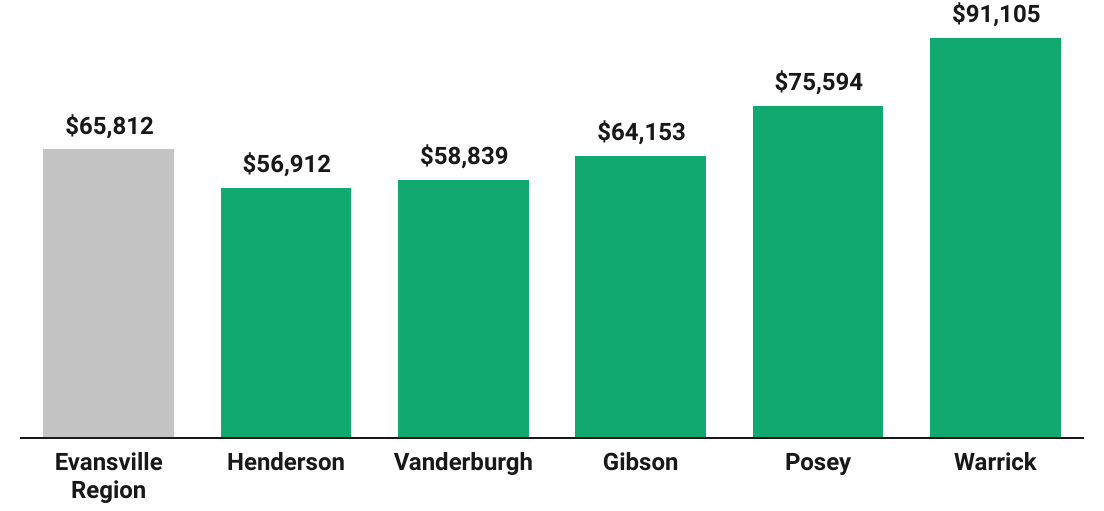
The Greater Evansville Region has a lower median household income ($65,812) than Indiana ($67,173) and the United States ($75,149). However, household income in the area varies across counties, with the lowest in Henderson ($56,912) and the highest in Warrick County ($91,105). Posey has the second-highest income ($75,594), followed by Gibson ($64,153), and both county’s income is above the region and Indiana average. Vanderburgh County has the second-lowest median income ($58,839), far below the US and Indiana averages.
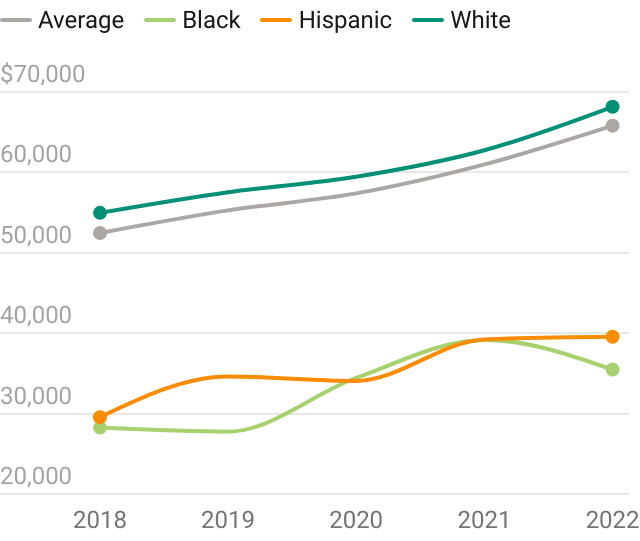
All racial groups in the region experienced an upward trend in median household income between 2018-2022. However, considerable variation exists among the groups. For example, White residents in the region consistently ranked higher in income compared to other groups and region average. Black and Hispanic residents consistently ranked lower compared to White and region average. While there is an increasing trend observed for both Hispanics and Blacks, the earning gap is still considerably high compared to whites.
Household income is twice as high for white householders compared to Black householders
Median household income by race
Median household income by county
Source: American Community Survey Five-Year Estimates
To obtain household income, the Census Bureau collects data on how much money households receive from 50 different sources, which includes earnings, pension, child support, public assistance, money received from rental properties, and interest. Usually, earnings are the primary sources of income, which are wages and salary from a job. In addition to median household income, we also analyzed how median earnings vary within the Greater Evansville Region and gender. We found that although the median annual earnings of women in the Greater Evansville Region ($35,218) are similar compared to Indiana women ($35,134), there is a gender gap that shows an income disparity in the region. The gender gap is the ratio of women’s median earnings to men’s for all full-time, yearround workers. The region has a gender gap of 0.66, which means that for each dollar men earn, women earn 66 cents. A lower gap indicates a higher disparity, and a higher gap shows less disparity. The gender pay gap disparity is highest in Posey County (0.60) and lowest in Henderson (0.76). Women who work full-time in Posey County earn $24,966 less per year than men who work full-time. The difference for Henderson is $11,029, the lowest in the region.
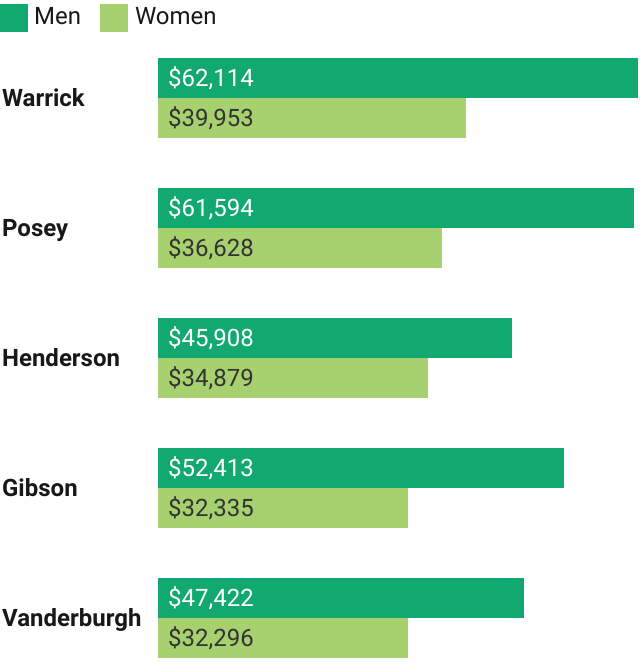
A gender pay gap is present in every county
Average earnings by by gender
Source: American Community
Survey Five-Year Estimates
Education
There is a large gap in educational attainment by race in the Greater Evansville Region. Black and Hispanic residents are more likely to not move beyond a high school diploma compared to White and Asian residents. When it comes to a college education, both Black (18%) and Hispanic population (15%) have the lowest rate of bachelor’s degrees or higher compared to White (21%) and Asian residents (58%). While educational attainment by foreign-born population for the Greater Evansville Region is not available at the Census, existing data for Indiana shows that nearly 36% of the foreign-born population reported having a bachelor’s degree or higher.
Education and income have a strong relationship, as more education is generally associated with higher income. The longitudinal data from 2010-2022 indicated that the income is consistently higher for employees with a higher degree. For example, in 2022, there is a $27,421 income difference between residents holding bachelor’s degrees and those without a high school diploma. People with bachelor’s degrees consistently ranked higher, indicating the value of having higher education. However, one of the reviewers of this report noted that although many foreign-born populations may have obtained a higher degree in their home country, they probably do not take advantage of having higher education since that degree may not be equivalent to U.S. degrees and likely not be considered in their workplace.
Educational attainment differs widely by race
Share of each race have attained a…

Earnings vary by education level, but is growing among all groups
Median earnings by highest level of education

Poverty
Poverty negatively impacts an individual’s quality of life, health status, education, and early childhood development. According to the most recent ACS data, households those are in poverty own homes at half the rate compared to the households are above the poverty line. The less a household earns, the more likely they are to experience high housing costs compared to income (ACS). Even though the poverty rate in our region is about the same as Indiana’s at 12.4%, there’s a noticeable difference when you look at it through the lens of race. Black and Hispanic communities are still facing higher poverty levels compared to their White and Asian neighbors. It’s worth noting that while there have been some improvements for these groups in recent years, the gap remains significant.
Vanderburgh County neighborhoods have the highest number or seniors, and some have the highest proportion, too.
Population aged 65 and older, count and percentage by census tract

Source: American Community Survey Five-Year
Estimates
Unemployment
The unemployment rate in the region improved in the last decade. For example, in 2010, the rate was 6.4 %, which decreased to 4% in 2022. Although the overall rate decreased, there is some difference by county. For example, in the region, Gibson and Posey counties have the lowest unemployment rate (2.8%), followed by Warrick (3.3%) and Henderson (3.8%). Vanderburgh has the highest unemployment rate (4.7%), slightly higher than Indiana’s average. Similar to income and poverty, we also see racial differences as Black residents consistently ranked higher than other groups.
Unemployment stabilized for white residents in 2017, a decade after the Great Recession. It is still falling for Black residents.
Unemployment rate by race (5-year rolling average)

Children in Need of Services
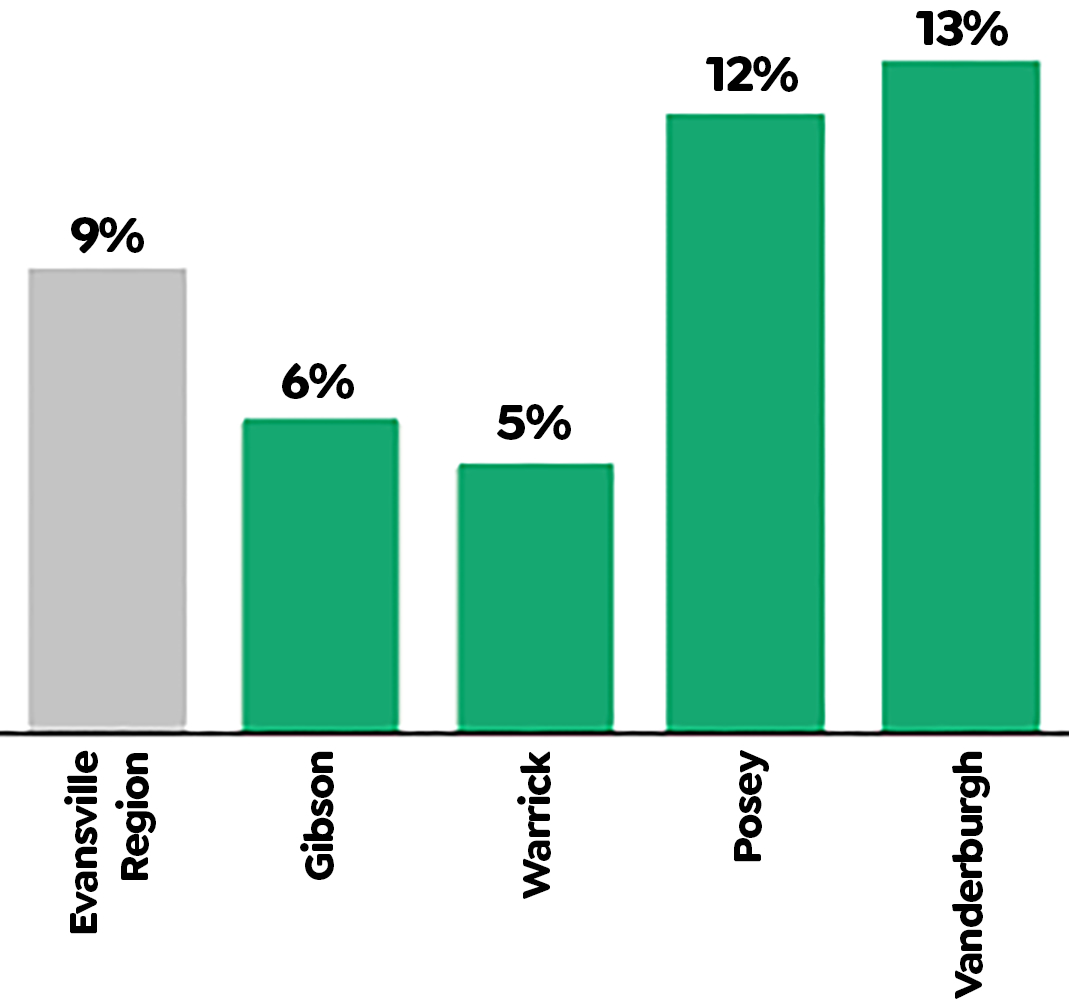
A Child in Need of Services (CHINS) is a legal process that provides services to children and their families when a child is experiencing abuse or neglect. When abuse or neglect is reported to the Department of Child Services and the Department brings a case to a juvenile court, the court can designate the child as “in need of services” and render a verdict requiring certain services. The region has a higher CHINS rate (9%) than Indiana (5%). In the region, Vanderburgh has the highest rate (13%), followed by Posey (12%) and Gibson (6%). Warrick ranks the lowest (5%) among other counties in the Greater Evansville Region.
One in eight children are legally defined as “in need of services” in Posey and Vanderburgh counties.
Percent of children declared Children in Need of Services
Source: American Community Survey Five-Year Estimates
Notes
Dave A. Chokshi. Income, Poverty, and Health Inequality (2018). https://jamanetwork.com/journals/jama/ fullarticle/2677433#google_vignette
Meger Kelsey Ms K. A Child’s Right to Counsel: The Case for Indiana to Craft Its Own Framework. Indiana Journal of Law and Social Equality. 2021;9(2):2.
Where You Live Matters is a product of Grow
in partnership with The Polis Center.
Guide