
What you'll find in this section
Data about
- Changing housing prices
- Homeowners and renters
- People experiencing homelessness
Key Findings
- Many Evansville residents have access to home ownership—70% of households own their home, but rising prices and tight supply are a stark challenge for the 24% of households who are burdened by housing costs.
- Eleven percent of households pay at least half of their income in housing costs. For renters, this rate is 21%.
- Sale price is up 43% in five years, average rent is up 22%, and average monthly costs for owners is up 19%.
- Vacancy rates are lower than Indiana (9%) and falling.
Where you live matters
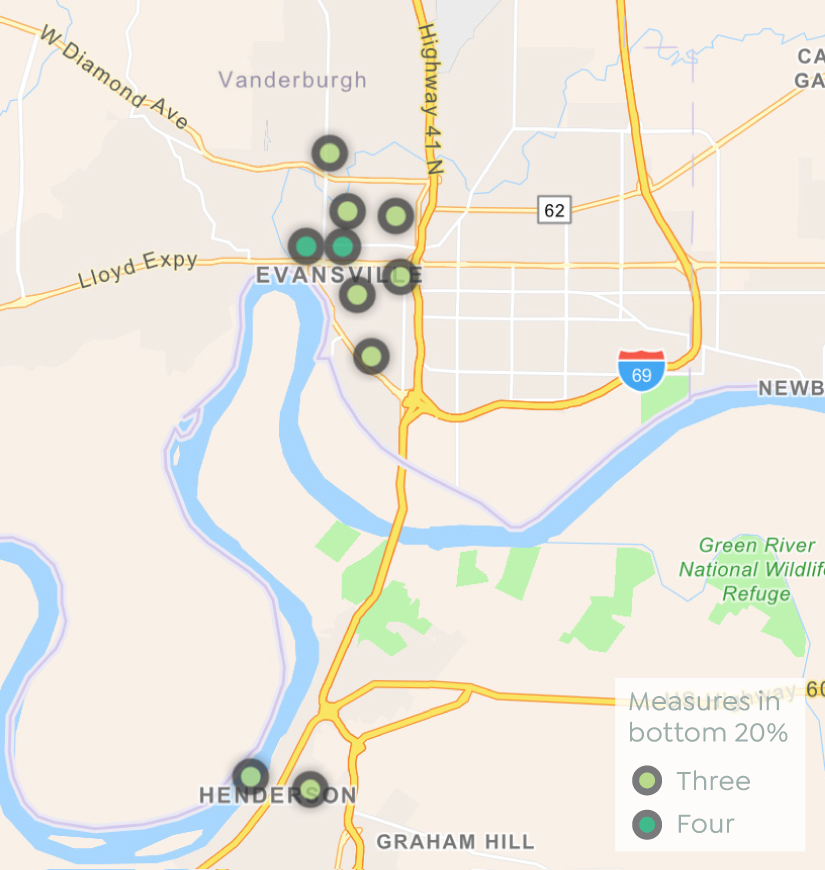
These areas ranked in the bottom 20% for at least three of these housing statistics:
- lowest homeownership rate
- lowest rent
- lowest mortgage costs
- and highest housing cost burden
There are 157,000 housing units in the Greater Evansville Region, mostly single-family homes built between 1940 and 1990. Multi-family units make up one fifth of the housing stock, and mobile homes make up 5%. The other 75% is single-family housing.
Less than one tenth of these units are vacant (9%). Some vacancy reflects a healthy housing market, one with enough open rental units and homes for sale that households can move if they want to. On average, 9% is a fairly healthy vacancy rate, but vacancy varies widely from neighborhood to neighborhood. In many neighborhoods in the urban core of Evansville, vacancy approaches 25%, whereas in most suburban areas it is below 5%. High vacancy can reduce property values and disincentivize investment, but low vacancy can drive up prices and make it difficult for people to move to an area.
Housing Costs
According to the Indiana Association of Realtors, the median sale price in the Greater Evansville Region through the first eight months of 2024 was $215,000. That is 16% lower than the state. (This data excludes Henderson County, Kentucky.) Evansville is an affordable housing market within an affordable state. Still, prices rose dramatically during the pandemic, with sale price increasing 43% since 2019.
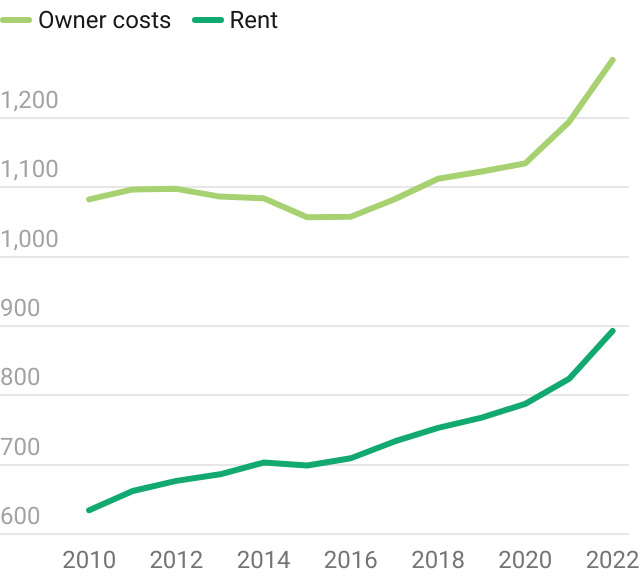
Median rent in the region was $893 per month from 2018-2022. Even this rolling five year average, which is not subject to rapid fluctuations, rose by 23% compared to the 2017 five-year average. The median rent in downtown Evansville is higher—$1,064 per month—while the average in the surrounding tracts ranges from $500-$750.
Median monthly housing costs for owners (which is mostly the cost of mortgage, but also includes utilities, taxes, and insurance) have risen 19%— from $1,083 in 2017 to $1,284 in 2022. These costs rose by $60 per month from 2020 to 2021 and $90 per month from 2021 to 2022.
One in four households are burdened by housing costs, meaning they pay more than 30% of their income toward housing. While this is on par with the Indiana average, the number of costburdened household is rising recently.
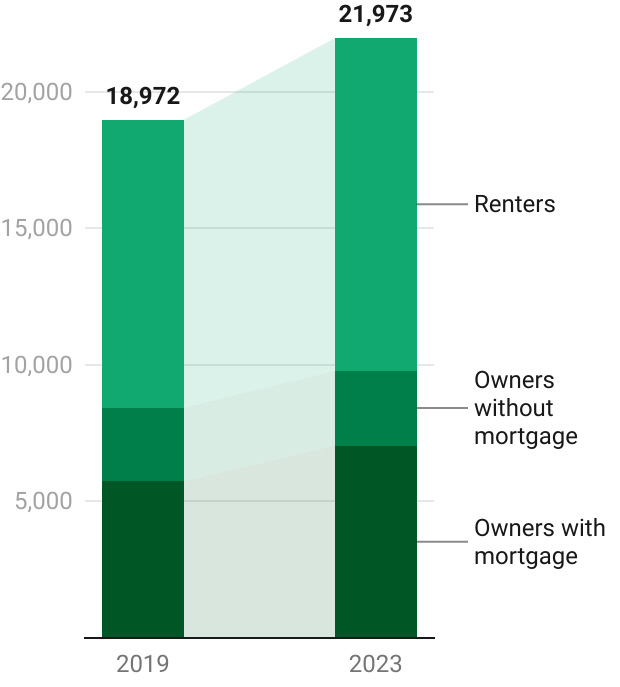
In Vanderburgh County, the number of owners with a mortgage who are burdened by housing costs rose from 5,700 in 2019 to 7,000 in 2023 (12% to 14%), and the number of similar renters rose from 10,500 to 12,200 (39% to 44%). The number of owners without a mortgage who are burdened by housing costs rose, too, from 10% to 14% as taxes and insurance costs increased. This data is from one-year averages of the American Community Survey. For the other, smaller counties in the region, the Census Bureau only publishes five-year averages, which are not sensitive enough to show this trend. Housing cost burden has been mitigated by rising incomes. Median household income averaged $65,812 between 2018 and 2022, which is 32% higher than the period ending in 2017. Per capita income also rose 28% over this period.
Housing costs went up exponentially after the pandemic
Monthly rent and owner costs (including mortgage, taxes, utilities, and insurance)
Source: 2022 5-Yr ACS via SAVI | Grow
Renters and owners with mortgages are increasingly burdened by housing costs
Households spending more than 30% of income of housing costs
Homeowners and Renters
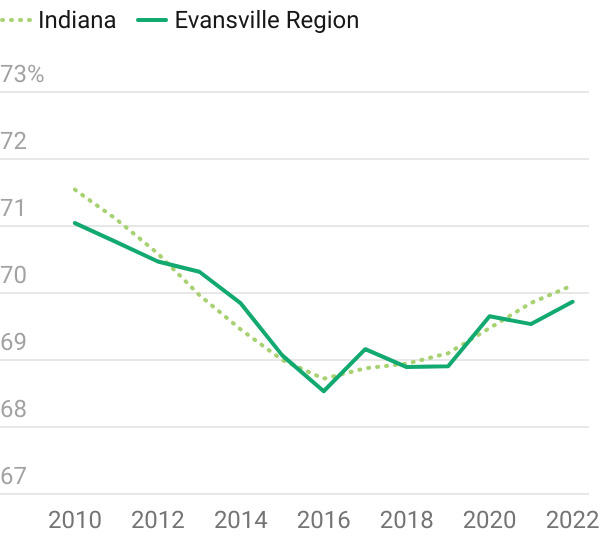
Seventy percent of households in the region own their home, on par with the Indiana average and slightly higher than the U.S. rate (65%). Homeownership has been fairly stable for the past decade, ranging from 69-71%.
The financial impacts of rising housing costs diverge significantly for homeowners compared to renters. For owners, the 43% increase in sale price in five years translates to equity. This asset is crucial to many people in accessing credit or funding retirement. Homeowners are also less likely to be burdened by housing costs—17% compared to 41% of renters in 2022.
Homeownership rate is similar to statewide average
Percent of households who own their home over time
Source: 2022 5-Yr ACS via SAVI | Grow
Spotlight on Renters Burdened by Housing Costs
For the 43,000 households in the region that rent, housing costs are a significant issue. Four in ten renters are burdened by housing costs, paying more than 30% of their income in rent, while 21% of renters are extremely burdened by housing costs. These households pay more than 50% of their income in rent.
These rates are even higher in some neighborhoods. In Tepe Park, Culver, and Goosetown, 50% of renters are extremely burdened by housing costs. One third of Tepe Park households rent, and half of the households in Culver and Goosetown rent their home.
This level of need is reflected in Indiana 2-1-1 call data. Hoosiers can call this line to be referred to programs and services, In the four Indiana counties that make up the Greater Evansville Region, people have placed 5,500 calls to the service so far in 2024 (through November 20). Housing is the top issue people call about (1,854 calls) and utility assistance is the third most common issue (916 calls).
Click here to explore SAVI data about housing-cost burden
Housing Conditions
Some areas in Evansville suffer from overcrowding and poor quality housing. On average, only one percent of households in the region are overcrowded (more than one occupant per room), but downtown this rate climbs to 5%. In Jacobsville, 11% of households are overcrowded. The state average is 2% for this measure.
Homes built before 1978 have a greater risk of contributing to lead poisoning. The original paint in these homes contained lead. In SAVI/Grow data, the closest category available is homes built before 1970. These are very prevelant downtown and in the surrounding neighborhoods, as well as in older subdivisions on the east side of Evansville. Downtown, 70% of homes were built before 1970. In Riverside and Center City Improvement Association (CCIA), half of homes predate 1970. In Tepe Park, over 90% of the homes were built before 1970. Lead poisoning has climbed in the region recently: In 2022, 0.9% of children had elevated blood levels, but in 2023 the rate increased to 1.6%. In Vanderburgh County this rate is 1.9%.
Click here to explore SAVI data about overcrowding
Unhoused People
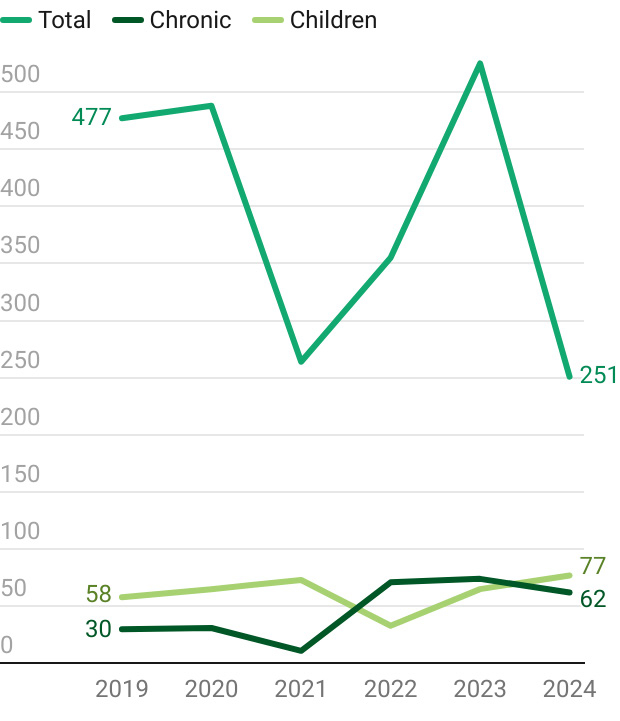
Each year, organizations and volunteers conduct a point-in-time count of unhoused people as mandated by the U.S. Department of Housing and Urban Development. From 2019 to 2024, the effort identified an average of 393 individuals per year, including 45 people experiencing chronic homelessness and 62 children.
The number of people identified as homeless fluctuates from about 250 (in 2024) to a high of over 500 (in 2023). The count fell from 2019 to 2022, rose again in 2023, and fell significantly in 2024. (The Indiana Housing and Community Development Association discouraging using 2021 data as a comparison because COVID-19 protocols artificially lowered the results.) The statewide count increased by 4% in 2024.
A significant drop in the count could be attributed to differences in data collection or simply changes in the weather or random chance. Counter to this trend, organizations that server people experiencing homelessness report “skyrocketing” numbers of clients.
Evansville’s unhoused population made up an average of 6.3% of the statewide unhoused population across 2023 and 2024. In the Greater Evansville Region, there were 135 people experiencing homelessness for every 100,000 residents. For comparison, this falls between the overall state average of 77 per 100,000 and Indianapolis’ rate of 171 per 100,000.
About 400 people are unhoused in Greater Evansville Region on average
Number of people counted in annual point-in-time homelessness count
Source: Indiana Housing and Community Development Authority
Where You Live Matters is a product of Grow
in partnership with The Polis Center.
Guide